
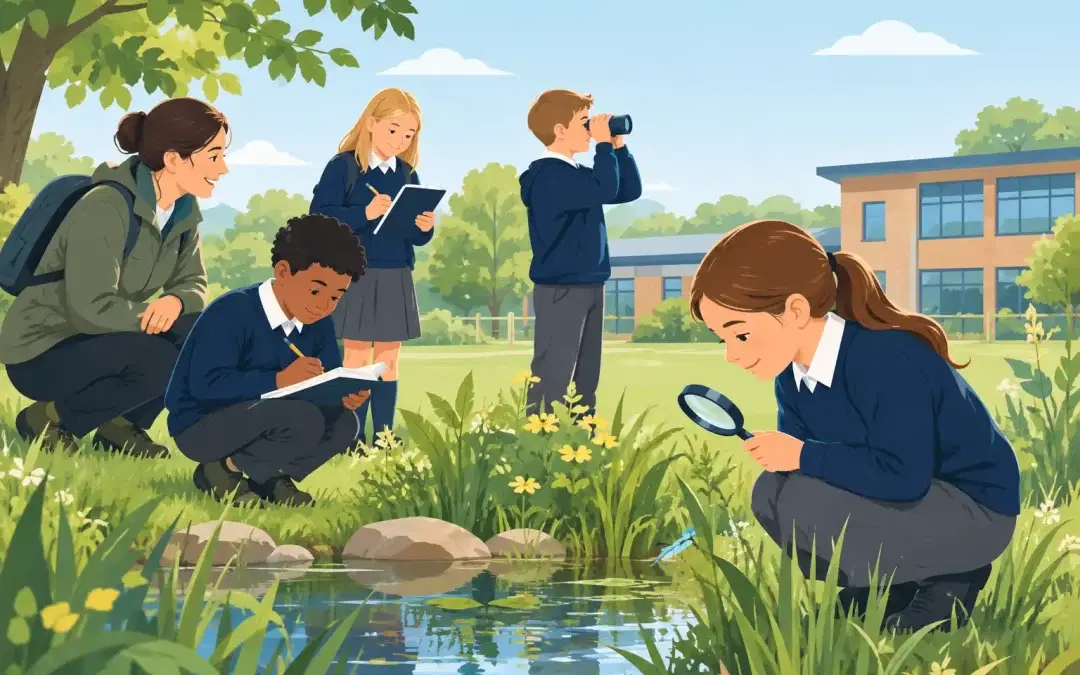
The walk from the classroom to the playground can become more than a change of location. With the right visual prompts on walls, fences and quiet corners, outdoor learning can reinforce a maths method, prompt a science question or help pupils revisit a shared school value before the bell rings. It gives busy school spaces a clear educational purpose without placing another demand on staff timetables.
For UK schools, this matters because outdoor areas are among the most heavily used parts of the site. Pupils pass through them at the start and end of the day, during break, lunchtime, PE and transitions. Too often, however, exterior walls are blank, faded or used only for temporary notices. A well-planned display scheme turns those repeated moments into passive learning opportunities that support the curriculum, wellbeing and school identity.
Why outdoor learning deserves a permanent place
Outdoor learning is sometimes understood solely as lessons in nature, gardening projects or forest school activities. These experiences have real value, but the opportunity is wider. A playground, courtyard or covered walkway can also become an extension of teaching when pupils are surrounded by clear, age-appropriate visual information.
Repeated exposure helps children become familiar with key vocabulary, number facts, timelines, maps and practical processes. A pupil may not stop to read every panel on the first day, but a display seen several times a week becomes part of the background knowledge they can draw on in class. For teachers, this creates useful starting points for short retrieval activities, walking discussions and transition-time questions.
The strongest approach is not to cover every available surface. An overloaded playground is as difficult to use as an overcrowded classroom wall. Instead, schools should choose a small number of high-value themes that match their curriculum priorities and the way pupils move around the site.
Learning that meets pupils where they are
The outdoor environment can be particularly helpful for pupils who respond well to movement, visual cues and informal opportunities to revisit learning. A multiplication panel beside a queueing area can support quick recall. A phonics or vocabulary display near an EYFS outdoor zone can encourage adult-led conversation. A science panel can make a practical observation feel connected to the knowledge pupils are building indoors.
There is also a wellbeing benefit in making shared expectations visible. Displays focused on kindness, resilience, regulation or positive behaviour provide language that pupils and staff can use consistently. They are not a replacement for relationships or careful pastoral support, but they help create an environment where the school’s values are present in everyday interactions.
Plan outdoor learning around the school day
The most effective outdoor displays begin with a simple question: where will pupils naturally pause, queue, play or pass by? Site managers and curriculum leaders can answer it together. This avoids installing excellent content in a location where it receives little attention.
Entrance routes and covered walkways suit content that welcomes pupils and reinforces identity, such as school values, house systems, local history or community rules. Playground walls work well for large-format curriculum graphics, active challenges and wellbeing messages. Areas near sports provision can support healthy lifestyles, anatomy, teamwork or inspirational role models. EYFS zones benefit from simple, colourful prompts that invite talk, counting, mark-making and imaginative play.
Consider the age range of pupils using each space. A detailed periodic table may be valuable outside a secondary science block, while a primary playground may need place value, times tables, world maps or a timeline that makes chronology easier to grasp. In mixed-use areas, displays should be readable at a glance and suitable for the youngest regular users.
Choose content with a clear teaching purpose
A panel earns its place when staff can use it. Before ordering, identify how each display will support a lesson sequence, a whole-school priority or a routine pupils already know. A history timeline can prompt retrieval at the start of a topic. A geography map can support comparisons between places. A food technology display can reinforce hygiene and nutrition before pupils enter the practical room.
This does not mean every graphic needs to be a formal lesson resource. Some of the best displays build culture rather than test knowledge. A visible statement of belonging, respect or aspiration can lift the tone of a communal area and give pupil voice a more permanent home. The balance depends on the school’s current needs.
Schools reviewing behaviour culture may prioritise values and regulation tools. Those strengthening subject leadership may choose curriculum-aligned panels by department. A new-build or refurbishment project may need a coordinated scheme that does both. The aim is a dynamic, immersive learning environment with enough clarity for pupils to understand what each space is for.
Make displays practical for outdoor conditions
An exterior graphic has to work harder than an indoor noticeboard. It must withstand rain, changing temperatures, direct sunlight and the constant contact of a busy playground. Materials and finish are therefore part of the educational decision, not just a purchasing detail.
For permanent outdoor learning displays, weatherproof composite-aluminium panels offer a dependable solution. They are rigid, durable and designed for exterior wall installation. UV-stable inks help colours and text remain clear in daylight, while a protective wipe-clean laminate makes everyday maintenance straightforward. This is especially useful where muddy hands, footballs and frequent use are part of normal school life.
Indoor displays have different requirements. Rigid foam-board panels are a practical choice for corridors, reception areas, dining halls and classrooms, where a clean, professional finish and manageable installation are important. Using the right material in the right place protects the budget and avoids replacing unsuitable displays before their educational value has had time to build.
Design for visibility, not just appearance
A polished design should still be easy to read from the distance pupils will normally stand. Large headings, clear contrasts and sensible amounts of text matter far more than decorative detail. Where a panel contains diagrams, maps or timelines, labels need enough space to remain legible rather than becoming a blur from the other side of the playground.
Customisation can make this work even harder for the school. Adding school colours, a logo, local landmarks, pupil-created rules or nearby historical references gives a display a sense of ownership. It signals that the message belongs to this community, rather than being borrowed from somewhere else. For pupils, seeing their school’s identity reflected around the site can strengthen pride and belonging.
Custom content is particularly valuable for local-history projects, values frameworks and multilingual communities. It does require a little more planning and approval time than selecting a ready-made subject panel. Yet where the purpose is to embed a distinctive ethos, that investment often produces a display staff return to year after year.
Help staff turn displays into everyday teaching tools
A permanent panel should make teaching easier, not create another resource that staff feel obliged to prepare around. The simplest way to achieve this is to introduce each new display with a few possible uses. Subject leads might suggest a retrieval question, a paired discussion prompt and a quick observation activity for each key panel.
For example, a primary maths wall can support a two-minute times-table challenge while pupils line up. A secondary geography display can be the basis for a starter question on migration, climate or settlement. A wellbeing panel might give a teaching assistant a shared visual prompt when helping a pupil name a feeling or choose a regulating strategy.
Pupil involvement is equally useful. Ask classes to suggest questions linked to a display, create temporary companion work for a nearby board or act as guides for younger children. When pupils help animate the space, outdoor learning feels less like decoration and more like a visible part of school life.
There is a practical maintenance benefit too. Staff are more likely to notice damage, outdated content or an ineffective location when the displays are actively used. A short annual review can confirm what remains relevant, what needs refreshing and where a new curriculum priority deserves a place.
Build a school environment that keeps teaching
School walls communicate even when no adult is speaking. They can say that learning belongs only in classrooms, or they can show pupils that knowledge, curiosity and shared values travel with them through the whole day. Purposeful outdoor displays make the second message visible.
Wall Graphics for Schools helps schools turn overlooked exterior surfaces into durable, curriculum-led resources, with weatherproof composite-aluminium panels, UV-stable inks and wipe-clean protection designed for demanding school environments. Panels can be supplied in manageable formats for straightforward in-house installation, helping schools improve a space without an unnecessarily complicated site project.
The best first step is often a walk around the grounds with fresh eyes. Notice the blank wall beside the playground gate, the sheltered route between blocks or the corner where pupils regularly wait. Each could become a small but lasting reminder that learning does not stop when the classroom door closes.