
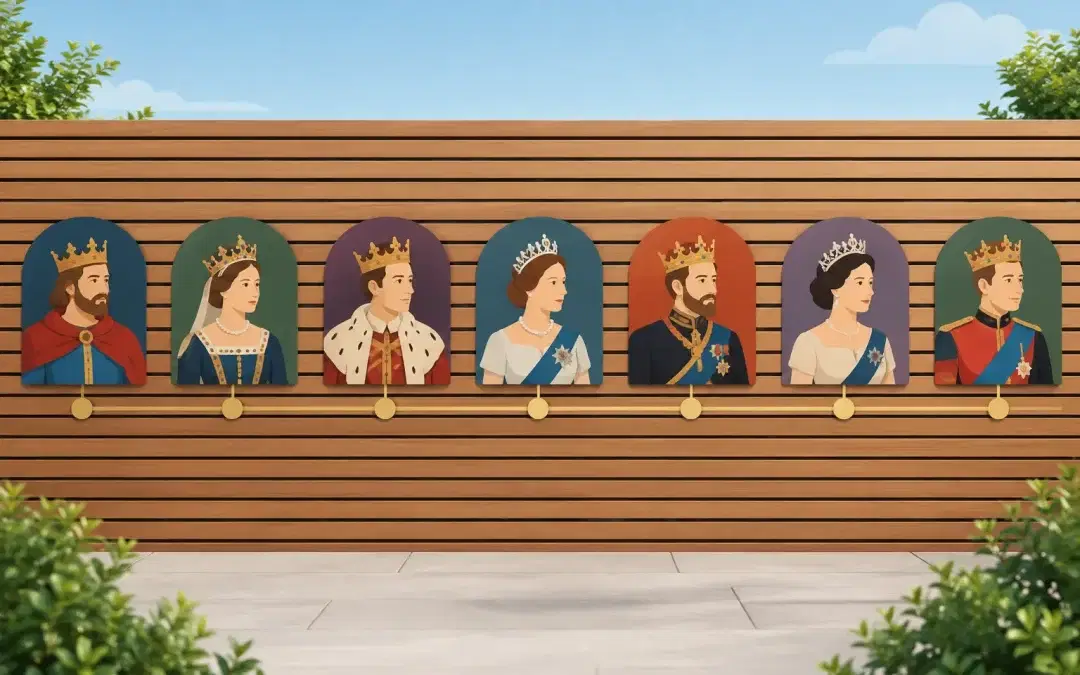
A pupil waiting outside the hall may only have a minute before lunch, but that minute can still reinforce a century, a dynasty or a turning point in British history. A kings and queens timeline display gives pupils a clear, always-visible route through the monarchs they meet in lessons, turning an underused corridor, classroom or library wall into a practical passive learning opportunity.
For schools, the value is not simply in presenting portraits and dates. A well-designed timeline helps pupils see sequence, duration, overlap and change. It gives staff a shared visual reference point for questions such as, “Who ruled during the Great Fire of London?” or, “Which monarch came before the Tudors?” Over time, those repeated encounters can make historical knowledge more secure and classroom discussion more confident.
Why chronology needs a visible home
Chronology is the framework that helps pupils make sense of history. Without it, significant people and events can become isolated facts: Henry VIII is associated with six wives, Elizabeth I with the Spanish Armada, Victoria with the Industrial Revolution. A timeline places these facts in relation to one another and shows that history is connected.
This matters across the primary curriculum and remains useful in secondary settings. Younger pupils can begin by recognising monarchs, ordering familiar names and spotting long and short reigns. Older pupils can use the same display to discuss succession, civil war, religion, empire, reform and the changing role of the monarchy. The wall resource does not replace taught history. It strengthens it by keeping the wider picture present between lessons.
A corridor display is particularly effective because it reaches pupils outside their usual history slot. It offers a prompt while classes are lining up, a conversation starter during a library visit and a visual anchor for staff revisiting prior learning. For schools building a more knowledge-rich curriculum, this repeated visual exposure supports the deliberate revisiting of key content without adding another worksheet or screen.
What a kings and queens timeline display should include
The strongest timeline is easy to scan from a distance but rewarding when pupils look closely. Clear monarch names, reign dates and a logical left-to-right sequence are essential. Colour-coded historical periods can make the structure immediately accessible, helping pupils distinguish the Normans, Plantagenets, Tudors, Stuarts, Hanoverians and the modern royal family.
Portraits are valuable too, particularly for younger learners and pupils who benefit from visual cues. They make the people behind the names memorable, while small symbols or carefully selected facts can prompt meaningful recall. A Tudor rose, a crown, a ship or a key event marker can encourage pupils to connect a monarch to a period of study without overcrowding the design.
There is a balance to strike. Too much text creates a wall that pupils are unlikely to read in passing. Too little context can make the display decorative rather than educational. The most useful format combines accurate core information with visual signposts that teachers can return to in lessons.
Decide where your timeline begins
Before selecting a display, schools should consider the intended curriculum focus. Many kings and queens timelines begin with 1066 and William the Conqueror, providing a clear starting point after the Norman Conquest and a manageable route to the present day. This works well where the display is intended to support National Curriculum history topics across Key Stage 2.
However, it depends on what pupils are being taught. A secondary department may need a longer chronology that acknowledges the Anglo-Saxon period and the separate histories of England, Scotland and Wales before the Union. A display focused on a particular topic, such as the Tudors or the English Civil War, may benefit from additional dates and events around the monarchs concerned.
Accuracy also requires care with contested successions and short reigns. The period known as the Anarchy, the reign of Lady Jane Grey and the relationship between English, Scottish and British monarchies are all opportunities for thoughtful teaching. A high-quality timeline should provide a dependable framework while leaving room for staff to explain the complexity behind it.
Make the display work beyond the history lesson
The best wall graphics earn their space by being useful to more than one year group or subject. In English, a kings and queens timeline can support Shakespeare, historical fiction and vocabulary around power, inheritance and monarchy. In art, pupils can compare portrait styles, clothing and royal symbolism. In geography, it can support discussions about kingdoms, borders, exploration and the growth of Britain’s global connections.
It can also give staff quick, low-preparation teaching prompts. Ask pupils to find the longest reign on the wall, identify which monarch was ruling during a studied event, or explain why the transition from one house to another matters. These short activities are useful at the start of a lesson, during a transition or as a retrieval task for a small group.
For SEND provision, a consistent, uncluttered visual resource can be especially supportive. Large type, high-contrast colours, meaningful images and a predictable sequence help pupils locate information independently. Positioning the display at an accessible height and avoiding a visually busy surrounding area will make it more effective for all learners.
Choose a location that encourages purposeful use
A long corridor is often the natural home for a chronological display because pupils can physically follow the passage of time as they walk along it. A school entrance or reception area can also create an immediate sense that learning is valued throughout the building, not limited to individual classrooms. Libraries, dining halls and routes to assembly spaces are other high-footfall locations with real potential.
The practical question is whether the wall can be read safely and comfortably. Avoid placing essential information behind doors, furniture or queues. Consider sightlines for pupils of different heights, and leave enough clear space for a teacher or class to stop nearby without blocking a busy route.
For outdoor learning areas, weatherproof materials are essential. Composite aluminium panels are designed to withstand playground conditions, while indoor rigid foam-board displays offer a lightweight, professional solution for corridors and classrooms. UV-stable inks help colours remain clear, and a wipe-clean protective laminate is valuable in the busy spaces where fingerprints, dust and day-to-day wear are unavoidable.
Build school identity into historical learning
A standard chronology can be highly effective, but bespoke design can make it feel like a purposeful part of your school rather than an addition to the wall. School colours, a logo, house names or a local-history reference can sit alongside the timeline without distracting from the historical content.
A school in a town with a royal connection, for example, might include a discreet local landmark or a relevant historical event. A curriculum lead may choose wording and visual cues that match existing knowledge organisers. This creates continuity between classroom resources and communal spaces, helping pupils recognise that the curriculum has been carefully planned.
Customisation should always serve learning. The display still needs generous spacing, readable dates and a sequence that is clear at first glance. When those fundamentals are protected, a bespoke kings and queens timeline becomes both a curriculum resource and a visible expression of school pride.
Plan for installation and long-term care
School teams need displays that are straightforward to manage as well as educationally worthwhile. Panelled formats are easier to carry through corridors, position accurately and install in-house than one large, awkward graphic. They also make it simpler to work around wall dimensions, fire doors and existing fixtures.
Before ordering, measure the usable wall area rather than the full length of the corridor. Check for sockets, radiators, alarm points and changes in wall surface. A timeline needs breathing room: compressing too many centuries into a narrow space can reduce readability and remove the visual impact that makes it useful.
Durability should be part of the decision from the start. In high-contact areas, wipe-clean laminated panels reduce maintenance demands and keep the display looking smart for longer. Choosing materials suited to the location protects the investment and gives staff confidence that the resource will continue supporting pupils year after year.
A well-placed timeline can become part of the language of the school. When a pupil can point to a monarch, connect a date to a topic and ask the next historical question, a previously blank wall has started doing meaningful educational work.