
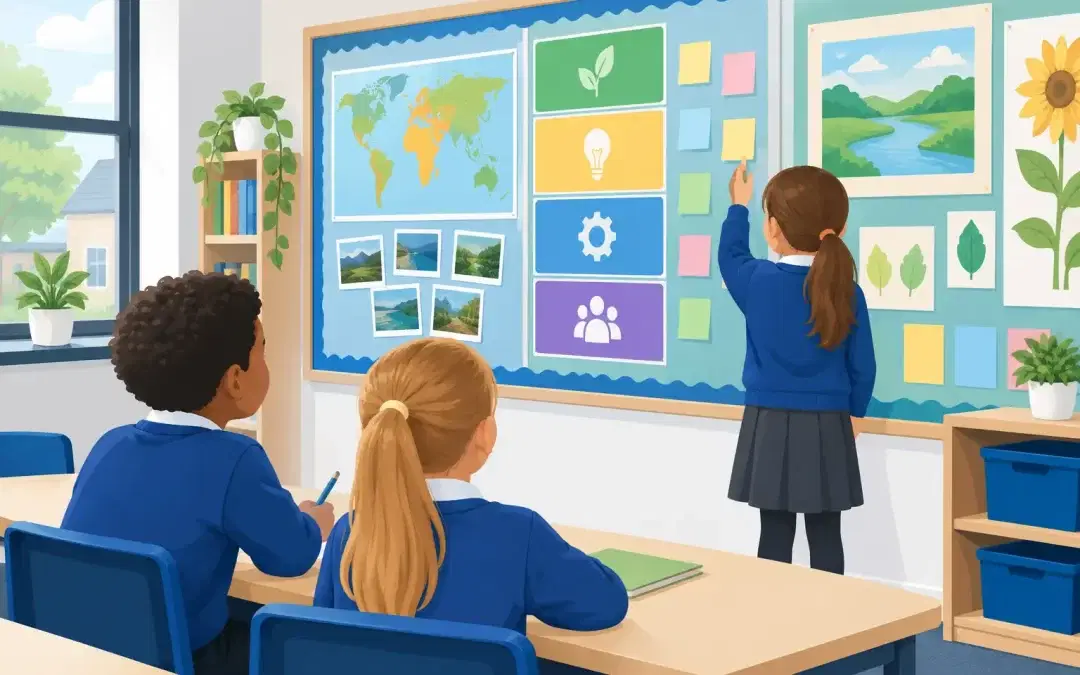
A blank corridor wall is more than unused space. It is a missed opportunity to reinforce vocabulary, prompt a useful question or remind pupils what their school stands for. Knowing how to plan learning walls well means treating every display as part of the learning environment, rather than as decoration to be changed when time allows.
The strongest learning walls support what pupils are already being taught, are easy to understand at a glance and remain useful long after a single topic has ended. They also need to work in the realities of a busy school: constant contact, limited staff time, varied reading ages and, often, a tight budget.
Start with the outcome, not the empty wall
It is tempting to begin with the space itself: a long corridor, a tired dining hall or a reception area in need of colour. Begin instead with the purpose. Ask what pupils should know, notice or feel after passing the wall several times a day.
A science display may be planned to reinforce key vocabulary before a unit begins. A historical timeline may help pupils place classroom topics in sequence across year groups. In a dining hall, a healthy eating graphic can create natural conversations at the point where choices are being made. Near the school entrance, values and community messages can give visitors, pupils and staff a clear sense of identity.
One wall does not need to achieve every aim. A display trying to teach a full curriculum topic, promote wellbeing, communicate behaviour expectations and celebrate pupil work can quickly become cluttered. Decide on one primary purpose and, where appropriate, one supporting purpose. This creates a clearer message and makes the wall more useful to staff.
Audit the journey pupils make each day
Learning walls work best when they are planned around movement. Walk the site at the beginning, middle and end of the school day. Notice where pupils queue, wait, line up, eat, arrive and transition between lessons. These are valuable moments for passive learning opportunities because pupils have time to look, read and discuss.
A wall outside a Year 3 classroom has a different role from one in a main corridor. Classroom-adjacent displays can support a current subject or a frequently revisited concept. Corridor graphics need to be more enduring, readable while walking and relevant to a wider range of ages. Reception areas should communicate school pride and welcome, while playground walls can encourage active learning, positive play and wellbeing.
Consider viewing distance before choosing content. A detailed map or timeline needs a place where pupils can stand close enough to explore it. A large values statement, multiplication prompt or inspirational literacy display can work from further away. If a wall is narrow, interrupted by doors or exposed to heavy traffic, a series of manageable panels is usually more practical than one oversized graphic.
Check the wall before planning the content
Measure the available area, but also note practical limitations. Look for radiators, noticeboards, switches, fire signage, uneven surfaces and areas likely to be knocked by bags or furniture. In communal areas, allow enough clear wall space for the display to read as a complete resource rather than a collection of fragments.
For exterior locations, assess weather exposure and how close pupils can get to the wall. Outdoor displays need to withstand rain, sunlight and regular use, while still remaining clear from a distance. Planning this early prevents a good educational idea being placed in the wrong setting.
Match content to curriculum and phase
The best learning walls make classroom learning more memorable without attempting to replace teaching. They repeat the language, concepts and visual cues pupils meet in lessons. That repetition matters: a pupil may not absorb every detail on their first pass, but familiar graphics can strengthen recall over weeks, terms and years.
For EYFS, use simple visual prompts, familiar routines and language that invites conversation. Alphabet, number, feelings, seasons, habitats and community themes can all support early vocabulary when images are clear and text is limited. Consider sightlines at child height, particularly for displays intended to be explored independently.
In primary settings, learning walls can connect knowledge across subjects. A British history timeline, for example, helps pupils locate Romans, Vikings, Tudors and significant local events within a bigger picture. Maths walls can reinforce number facts, times tables, shape and measure. Geography graphics may support map skills, continents, climate zones or fieldwork vocabulary.
Secondary schools may benefit from subject-specific displays near departments, as well as whole-school graphics in shared spaces. Literature quotations, scientific method prompts, food technology processes, careers pathways and revision language can give students quick visual anchors between lessons. The right level depends on the age group and the curriculum sequence. A display should stretch pupils without becoming so dense that it is ignored.
Where possible, involve curriculum leads early. They can check terminology, identify misconceptions and make sure the display complements planned teaching. This small step helps a wall retain its value beyond a single themed week.
Plan for belonging as well as knowledge
A purposeful school environment teaches more than subject content. Learning walls can make culture visible: how pupils treat one another, what the school believes in and whose stories are recognised in the building.
Values displays work particularly well in entrances, halls and shared corridors because they give staff a consistent reference point. Rather than relying only on broad words such as respect or resilience, connect values to observable actions. What does respect sound like in the playground? What does resilience look like when work is difficult? Practical wording gives pupils language they can use.
Bespoke content can make this even more meaningful. A local-history panel, school logo, house colours, pupil-created motto or community rules can turn a generic area into a place that clearly belongs to its school. This is especially useful when welcoming new families, supporting transitions or refreshing a tired site without major building work.
Choose a format that staff can maintain
Temporary paper displays have their place, particularly when showcasing pupil work or responding to a short classroom project. However, high-use curriculum and culture messages are often better planned as permanent or long-lasting graphics. Staff should not have to recreate foundational knowledge displays every term because paper has curled, faded or been damaged.
For indoor walls, rigid foam-board panels offer a clean, lightweight solution that is manageable for in-house installation. A wipe-clean protective laminate is valuable in corridors, dining spaces and other areas where fingerprints, scuffs and everyday cleaning are unavoidable. UV-stable inks also help colours stay clear and vibrant over time.
For playgrounds and exterior walls, weatherproof composite aluminium is the more suitable choice. It is designed for the demands of outdoor school life and gives pupils a durable resource beyond the classroom. Material choice is not simply a procurement detail. It determines whether a learning wall remains a useful part of the environment or becomes another maintenance task.
Build a coherent visual system
A school does not need every wall to look identical, but learning displays should feel connected. Agree a small number of design principles before ordering: school colours, typefaces, icon style, panel sizes and the balance between imagery and text. This makes future additions easier to plan and helps pupils recognise learning resources across the site.
Keep language concise. A wall is not a worksheet, and pupils may see it while moving. Use headings that make sense immediately, carefully selected visuals and key facts with enough space around them. For more detailed subjects, use a layered approach: a clear main idea visible from a distance, followed by smaller facts that reward a closer look.
Accessibility should be part of the first design conversation, not a last-minute adjustment. Strong contrast, readable type, uncluttered layouts and meaningful images help all pupils, including those with visual processing needs or additional learning needs. Avoid relying on colour alone to communicate an instruction or category.
Make implementation straightforward
Before placing an order, create a simple wall plan that records the location, purpose, audience, dimensions, material and responsible lead for each display. This is particularly useful when several departments are involved or when a school is developing its environment in phases.
A phased approach often makes financial sense. Start with the highest-impact spaces: the entrance, main corridor, dining hall, key subject areas or playground. Review how pupils and staff use them, then extend the approach as budget allows. Wall Graphics for Schools can also create customised panels that incorporate a school’s branding, local context and chosen messaging, helping each phase feel part of one coherent scheme.
Plan installation around the school calendar. Half-term breaks, inset days and quieter periods make fitting easier, but manageable panel formats allow many displays to be installed by site teams without a major disruption. Confirm surfaces are clean, dry and suitable before installation, and retain a record of panel positions for future maintenance or expansion.
Review what pupils actually use
Once the walls are in place, do not assume the job is finished. Ask teachers whether they reference the displays in lessons. Listen for pupils using the vocabulary on the wall. Watch whether a playground activity panel encourages interaction, or whether a corridor timeline prompts questions.
If a display is rarely noticed, the issue may be placement rather than content. If pupils engage with the images but not the wording, simplify the language or add a teacher prompt nearby. A well-planned learning wall should become easier to use over time as staff build it into routines, transitions and conversations.
The most effective school walls do not demand attention. They earn it, day after day, by giving pupils something useful to revisit, recognise and feel proud of.