
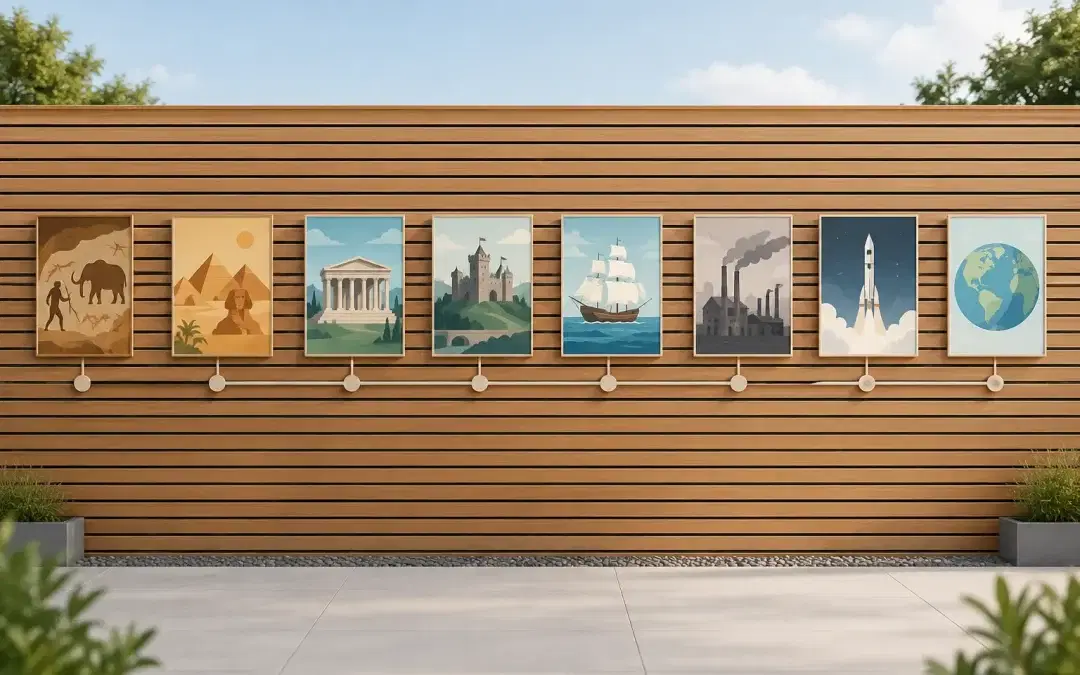
A history of the world timeline wall display can turn the walk from one lesson to the next into a valuable moment of recall. Rather than keeping chronology inside an exercise book or on a classroom screen, it gives pupils a permanent visual reference for the civilisations, movements and events they are studying. For a school, that means an underused corridor, library or dining hall wall can become part of the history curriculum.
The most effective displays do more than present a row of dates. They help pupils understand what happened at the same time in different parts of the world, place British history within a wider global context and build the chronological vocabulary needed to discuss the past with confidence. Used well, a timeline becomes a shared reference point for teaching staff and a source of passive learning opportunities throughout the day.
Why chronology needs a visible place in school
Chronological understanding is fundamental to history teaching, but it can be difficult for pupils to retain when topics are taught separately across a term or year. A pupil may learn about the Romans in one unit, the Anglo-Saxons in another and the Second World War much later, without immediately seeing the distance, sequence and connections between them.
A large-format wall display makes those relationships visible. Pupils can see that Ancient Egypt came before Ancient Greece, that the Maya civilisation developed across a very different timescale to medieval Britain, or that significant changes in science, industry and society often happened alongside political change. This supports the language of before, after, century, decade, ancient and modern in a way that is easy to revisit.
Repeated visual exposure matters. When a timeline is displayed in a busy shared space, teachers can point to it during a lesson transition, pupils can refer to it while preparing an assembly contribution, and families may notice it at an open evening. The information is not dependent on a particular class timetable. It becomes part of the school’s learning culture.
What a history of the world timeline wall display should include
A useful world history timeline needs a clear structure before it needs more content. It should guide pupils through broad periods without making the past appear as one uninterrupted story led by a single country or culture. The best approach is to show major eras clearly, then use carefully selected examples to illuminate the diversity within them.
For primary schools, this may mean using accessible milestones such as prehistoric Britain, Ancient Egypt, Ancient Greece, the Roman Empire, the Shang Dynasty, the Maya, Benin, the Islamic Golden Age, the Viking age, medieval kingdoms, the Industrial Revolution and the modern world. Short explanations, illustrations and recognisable visual cues help younger pupils make meaningful connections without overwhelming them.
For secondary settings, a display can carry greater depth. It may include political revolutions, imperial expansion and resistance, migration, technological change, world conflicts, decolonisation, civil rights movements and significant developments in medicine, communication and space exploration. Dates still matter, but they should sit alongside themes that prompt enquiry. A timeline should encourage questions such as: whose experiences are represented, what changed, what stayed the same, and how did events in one place affect another?
There is a balance to strike. Too little detail produces a decorative line of dates that pupils soon ignore. Too much text makes the display difficult to use from a distance. Concise descriptions, a consistent scale and carefully chosen imagery create a clearer learning resource than densely packed facts.
Build local and national history into the bigger picture
Global history is most powerful when pupils can connect it to the place they know. A school can add local industries, notable residents, migration stories, heritage sites or community milestones alongside national and worldwide events. This makes the curriculum feel immediate while helping pupils understand that their town, city or region has its own place in the wider story.
Customisation also allows a timeline to reflect the school’s curriculum sequence. If Year 5 studies the Vikings in autumn and local history in summer, key points can be highlighted in a way that supports planned teaching. School colours, logos and familiar visual identity can make the display feel owned by the whole community rather than borrowed from a textbook.
Choosing the right location and format
A timeline must be visible enough to become useful. Long corridors work particularly well because pupils naturally follow the sequence as they move along the wall. Dining halls, libraries, stairwells and reception areas can also provide high-footfall locations, provided there is sufficient space to read the content safely and without congestion.
Consider the viewing distance before selecting panel sizes and text scale. A display beside a queue should be legible at a glance, while a library wall may support more detailed information for pupils who pause to explore it. Breaking a long timeline into manageable panels can make installation simpler and allow schools to adapt the layout around doors, radiators, noticeboards or existing fixtures.
Indoor displays need to withstand the reality of school life: bags brushing past, hands touching surfaces and frequent cleaning. Rigid foam-board panels with wipe-clean protective laminate provide a practical option for corridors and communal areas. The smooth surface protects the printed design while keeping maintenance straightforward for busy site teams.
For playgrounds, covered walkways and exterior teaching spaces, weatherproof composite-aluminium panels are the more suitable choice. UV-stable inks help maintain clear, vibrant graphics in changing weather and sunlight, allowing schools to extend history learning beyond the classroom. An outdoor timeline can be especially effective for pupils who benefit from movement, fresh air and short, structured learning prompts during breaktimes.
Make the display active, not just attractive
A wall display earns its place when staff can use it easily. The simplest activities are often the most effective: ask pupils to locate the period they are studying, identify what came immediately before it, or find another event taking place elsewhere in the world at a similar time. These quick prompts reinforce prior knowledge without requiring extra preparation.
A history lead might use the timeline to introduce a new unit, while form tutors can build a weekly historical anniversary into morning registration. During an open evening, pupils can use it to explain their current learning to parents and carers. This flexibility gives the display value across subjects, year groups and school events.
It should not replace maps, artefacts, historical sources or carefully planned classroom teaching. Timelines simplify a complex past, and dates alone do not explain cause, consequence or interpretation. Their strength lies in providing the framework that helps pupils organise those richer pieces of learning.
Schools can also use the display to support inclusion. Clear imagery, readable typography and concise language make information more accessible for many learners, including pupils who benefit from visual prompts. Where appropriate, symbols, colour-coded eras and repeated vocabulary can reduce cognitive load. At the same time, content should avoid presenting cultures as isolated curiosities or treating difficult historical subjects without care and context.
A long-term investment in purposeful walls
Blank walls and tired displays ask nothing of a school community. A carefully designed timeline gives those surfaces a job: to prompt curiosity, reinforce curriculum knowledge and create pride in a dynamic, immersive learning environment.
Wall Graphics for Schools can tailor a world history timeline around your school’s age range, available wall space, curriculum priorities and local context. Panels are supplied in manageable formats for straightforward in-house installation, helping schools make a visible improvement without an unnecessarily complicated project.
The right display will not simply tell pupils what happened in the past. It will give them a dependable place to return to, helping each new topic find its place in the much bigger human story.