
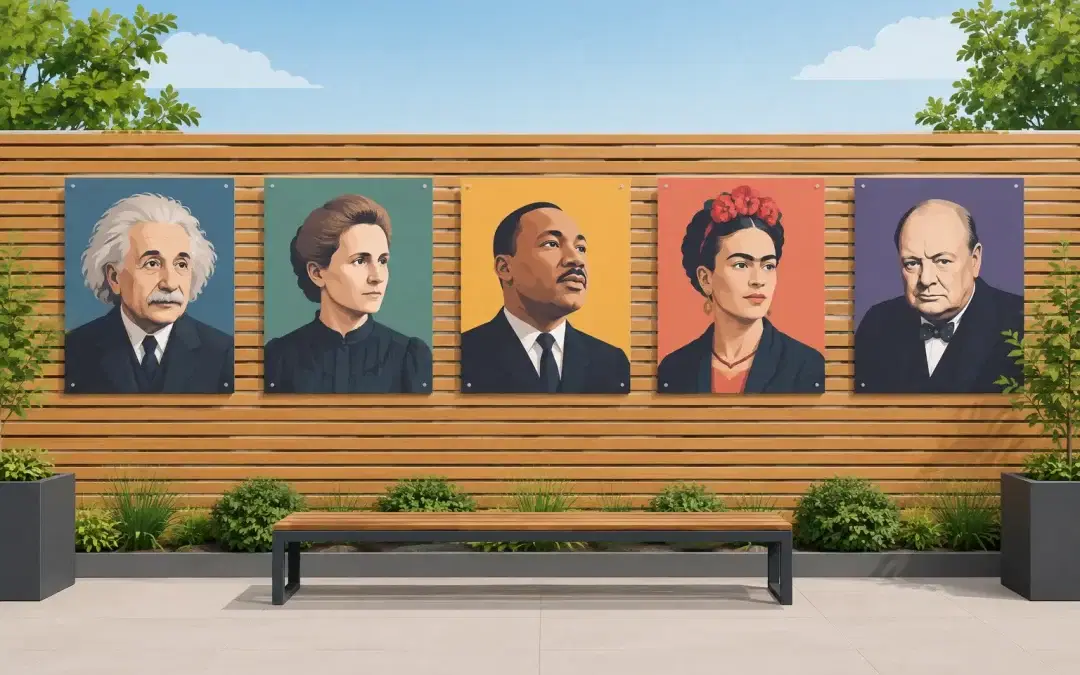
A corridor between lessons can become one of the most valuable history resources in the school. A famous historical people wall display gives pupils regular, low-pressure encounters with the people behind the periods, movements and discoveries they study. Instead of passing a blank wall, they might meet Mary Seacole, Alan Turing, Emmeline Pankhurst or Nelson Mandela several times a day – building familiarity before, during and after classroom teaching.
For busy schools, this is not about adding decoration for its own sake. It is about creating passive learning opportunities that support curriculum knowledge, prompt meaningful conversations and show pupils that history is made by people with ideas, choices and consequences.
Why famous historical people wall displays work
History can feel remote when pupils encounter it only as a sequence of dates, events and textbook extracts. A well-designed display gives that knowledge a human focus. Seeing a portrait alongside a clear, age-appropriate explanation helps pupils connect an individual to a wider historical story: Florence Nightingale to healthcare reform, Rosa Parks to civil rights, or William Wilberforce to the abolition movement.
Repeated visual exposure matters. Pupils may not stop to read every panel on the first day, but regular journeys through a corridor, library, hall or dining area create valuable recognition. Names become more familiar. Key vocabulary is revisited. A child waiting outside a classroom may notice a date, a quotation or a detail that helps them contribute with confidence in a later lesson.
This is particularly useful at transition points. The minutes spent lining up, moving to assembly or waiting for a teacher are often difficult to use purposefully. A history wall can turn those moments into prompts for recall: Who was this person? What change did they help bring about? Which period have we learned about that links to them?
A display also widens the school’s visible historical narrative. Pupils should be able to see influential figures from different cultures, eras and fields of achievement, rather than receiving a narrow impression of who shapes history. Careful selection can support a more representative curriculum while giving staff a practical starting point for discussion.
Planning a famous historical people wall display
The strongest displays are planned around what pupils are learning, not simply around the most recognisable names. Begin with your curriculum map. A primary school may want figures that connect directly to topics such as the Romans, significant people, the Tudors, Victorians, World War Two and local history. A secondary department may need a more detailed chronology or displays that reinforce disciplinary themes including democracy, empire, migration, medicine, protest and scientific development.
There is a balance to strike between breadth and depth. A large collection of portraits can create impact, but too many names in one space can dilute the learning. In a narrower corridor, a focused set of six to ten figures with concise text is often more effective than a crowded timeline. In a library or main hall, a wider historical gallery can give pupils a sense of connection across centuries.
Age matters too. EYFS and Key Stage 1 pupils benefit from clear portraits, simple language and memorable facts. For older pupils, panels can include dates, historical context, key terminology and a short quotation or source-based question. The best wording invites thought without turning every display into a worksheet.
Questions are especially useful where staff want the display to support oracy. A panel on Malala Yousafzai might ask why education can be a human right; one on Isambard Kingdom Brunel might prompt pupils to consider how engineering changes daily life. These questions do not need immediate written answers. They give adults and pupils a natural way to begin a conversation.
Build connections, not a wall of isolated portraits
A famous historical figure becomes more meaningful when the display makes their connections clear. Group people by period, theme or idea where appropriate. For example, a civil rights section could introduce Rosa Parks, Martin Luther King Jr and Claudia Jones. A science and innovation area might place Ada Lovelace, Charles Darwin, Katherine Johnson and Tim Peake within a wider story of enquiry and discovery.
However, thematic grouping is not always the right answer. If pupils are developing chronological understanding, a timeline structure may be more useful. It depends on the intended learning outcome and the space available. A history lead may prioritise sequence and causation, while a pastoral or enrichment lead may want a broader display of inspirational individuals from across the curriculum.
Local relevance can make the difference between a good display and one pupils truly own. Local reformers, artists, industrial heritage, sporting figures or community stories can sit alongside nationally and globally significant people. This approach helps pupils see that history is not only something that happened elsewhere.
Choose materials that suit a busy school
A display needs to cope with the realities of school life: bags brushing against it, fingers pointing at facts, cleaning routines and constant use of communal spaces. Paper posters may be suitable for temporary classroom work, but they can quickly look tired in high-traffic areas.
For interior corridors, halls, libraries and classrooms, rigid foam-board panels offer a smart, practical finish while remaining manageable for in-house installation. A wipe-clean protective laminate helps staff keep the surface fresh and presentable, particularly where younger pupils are likely to touch and explore the display.
Outdoor learning areas need a different specification. Composite aluminium panels are designed for exterior walls and playground environments, providing a weatherproof solution that continues learning beyond the classroom. UV-stable inks are important here, helping colours and text remain clear when displays are exposed to daylight over time.
Material choice should reflect location, not just budget. A lower-cost temporary display may be right for a short project, while a permanent corridor installation deserves a finish that supports years of daily use. Choosing durable panels can reduce the time and cost of replacing damaged or faded resources later.
Make the display part of everyday teaching
A history wall has the greatest value when staff can use it without creating extra preparation. Teachers might begin a lesson by asking pupils to find the figure linked to the topic, return to a panel for retrieval practice, or ask a pupil to explain one fact they noticed during the week. Teaching assistants can use the visuals during small-group conversations, while lunchtime or library staff can encourage curious questions.
Displays are also useful beyond history lessons. A quotation from a campaigner can support a writing task. A scientist’s achievements can strengthen a STEM week. A figure who overcame discrimination, displacement or adversity may connect carefully to values education, wellbeing and belonging. The aim is not to turn every individual into a simplistic role model, but to present their contribution honestly and in context.
Pupil involvement can add further impact. Older children might research an additional local figure, write a short interpretation for a changing panel, or vote on whose story should feature next. This keeps the environment dynamic while retaining a clear, professionally produced visual foundation.
A display that reflects your school
A generic set of historical figures can be highly effective, but customisation makes it easier to align the display with your curriculum, ethos and identity. School colours, logos and house values can be incorporated without distracting from the historical content. Bespoke wording can reflect the vocabulary pupils use in lessons, while local-history panels can make the learning immediately more relevant.
Wall Graphics for Schools can produce curriculum-aligned history graphics in manageable panel formats, allowing schools to select the people, themes and locations that work for their site. This is useful where a school wants a coordinated approach across corridors, reception areas, libraries and outdoor spaces rather than a collection of unrelated posters.
A purposeful wall does more than fill space. When pupils regularly see the people, ideas and struggles that have shaped society, the building itself begins to reinforce the message that knowledge is worth noticing, discussing and carrying with them.