
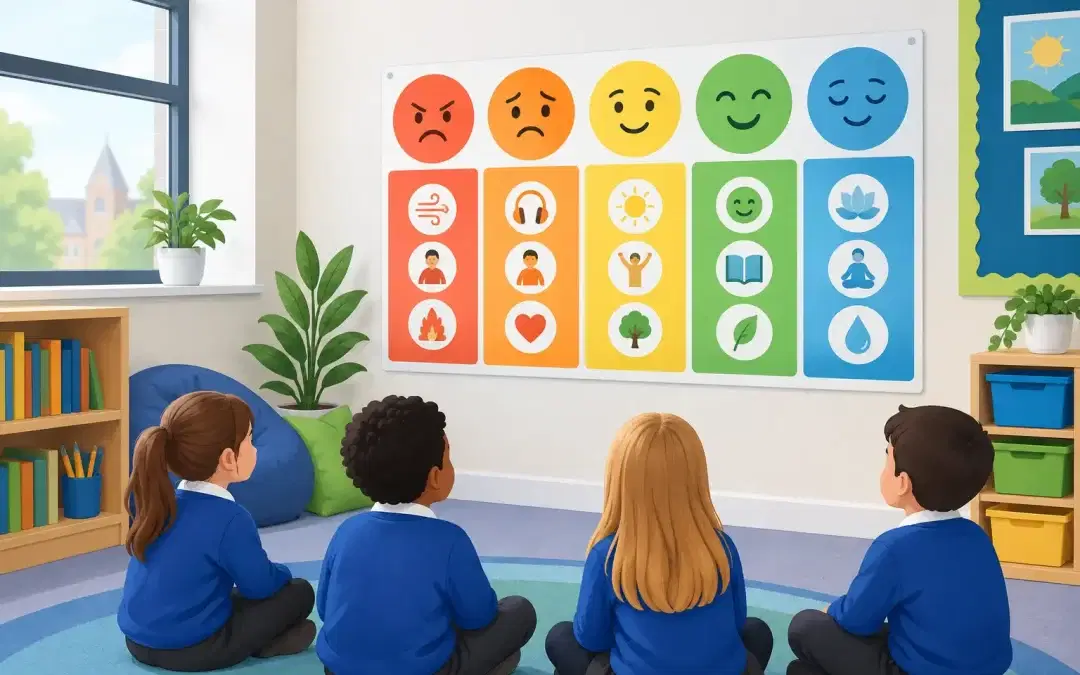
A pupil who is overwhelmed in a busy corridor rarely needs another instruction to “calm down”. They need a clear, familiar prompt that helps them name what is happening and choose a next step. Emotional regulation displays for schools make those prompts visible at the point they are needed – outside classrooms, in nurture areas, beside dining halls and across the playground.
For pupils, this can turn a difficult moment into a manageable one. For staff, it creates shared language that supports the approaches already used in classrooms, pastoral care and behaviour systems. A well-planned display is not a replacement for trusted adult support or a school’s wellbeing provision. It is a practical, always-visible resource that makes self-regulation strategies easier to recall when words are hard to find.
Why visual prompts support emotional regulation
Emotional regulation is the ability to notice feelings, understand their intensity and respond in a way that is safe and helpful. Children and young people develop this over time, through relationships, modelling, routines and repeated practice. In a pressured moment, however, even a pupil who knows a strategy may struggle to retrieve it.
Visual displays reduce that recall burden. A simple feelings scale, a set of calming choices or a clear sequence such as “pause, breathe, choose, return” provides a prompt without placing further demands on a pupil’s working memory. Repeated exposure matters too. When the same language and imagery appears in several spaces, pupils become more likely to recognise it as part of the school’s everyday culture rather than something reserved for a sanction or intervention.
This is particularly valuable during transition points. Corridors, cloakrooms, lunch queues and playground entrances can be high-energy spaces where small frustrations escalate quickly. A purposeful wall can offer a moment of orientation: What am I feeling? What could help? Who can I speak to? These are passive learning opportunities, but their effect can be very active.
What effective emotional regulation displays for schools include
The strongest displays are clear enough to use at a glance. They avoid overcrowding, vague slogans and language that feels too clinical for the age group. Instead, they offer a manageable route from recognising an emotion to selecting a practical response.
A primary school might use accessible feeling words alongside expressive illustrations and simple strategies: take five slow breaths, get a drink of water, ask for help, use the quiet space or move your body safely. For EYFS, visual cues and short phrases are especially useful, with adults modelling the language consistently. Secondary pupils generally respond better to more age-appropriate wording that respects their growing independence, such as noticing stress signals, taking a reset and choosing a constructive action.
A feelings thermometer, regulation zone or check-in scale can work well where it aligns with the school’s established approach. The important point is consistency. Introducing a new model solely because it looks attractive can confuse pupils and create extra work for staff. A display should reinforce the terminology teachers, teaching assistants and pastoral teams already use.
It should also make room for the reality that there is no single correct emotion. The goal is not to insist that every pupil feels happy all day. It is to show that all feelings can be acknowledged, while actions still need to be safe, respectful and proportionate. That distinction helps schools promote emotional literacy without reducing wellbeing to a motivational poster.
Keep strategies specific and achievable
“Make good choices” is a worthwhile aspiration, but it gives little guidance to a pupil who is angry, anxious or embarrassed. Specific options are more usable. A display might prompt pupils to breathe slowly, count backwards, draw, talk to a trusted adult, take a supervised movement break or use an agreed calm area.
The best choice depends on the setting. A corridor panel needs concise prompts that can be read while walking past. A wellbeing room can include more detail, reflective questions and step-by-step regulation techniques. Outdoor panels may focus on fair play, resolving friendship difficulties and how to rejoin learning after a disagreement.
Position displays where regulation happens
One large wellbeing wall in reception can communicate a positive message to visitors, but it may have limited day-to-day value for pupils. Regulation support works best when it appears in the spaces where children actually encounter pressure, change or social complexity.
Consider classroom entrances and shared corridors for reminders before lessons begin. Dining areas can carry prompts about waiting, noise, personal space and asking for help. Near the playground, use simple guidance for managing winning, losing, turn-taking and friendship problems. A reflection or nurture space can accommodate more detailed material, including agreed de-escalation routines.
Placement must remain sensitive. Displays should guide and encourage, not label a particular pupil group or imply that certain children are always a problem. Inclusive wording such as “When feelings feel big” is often more welcoming than language focused only on poor behaviour. It also supports the whole school community, including pupils who are quiet, worried or reluctant to draw attention to themselves.
Make the display part of staff-led practice
A wall graphic becomes more useful when adults refer to it naturally. During a class check-in, a teacher might point to the feelings language pupils have been learning. Following a playground disagreement, a midday supervisor can use the nearby strategy panel to support a restorative conversation. Over time, pupils begin to use the wording themselves.
This does not require a complicated launch programme. It does require agreement. Staff should know what the display is intended to reinforce, the strategies pupils are expected to use and when adult support is needed. For some pupils, particularly those with additional needs, visual regulation prompts may form one element of a more personalised plan. The display can provide familiarity, but it should never replace individual assessment, reasonable adjustments or professional support.
Pupil voice also improves relevance. Ask pupils which feelings are hardest to describe, which situations feel challenging and what helps them reset. Their answers may reveal that a crowded lunch hall needs a different prompt from a Year 6 corridor, or that older pupils want a discreet check-in message rather than cartoon-style imagery.
Choose materials that withstand a busy school day
Wellbeing messages lose impact when displays are peeling, faded or difficult to clean. School walls experience constant contact from bags, hands, chairs and cleaning routines, so material choice is an operational decision as well as a design one.
For indoor corridors, classrooms and communal areas, durable rigid foam-board panels create a professional finish while remaining manageable for in-house installation. UV-stable inks help colours and text remain clear, while a wipe-clean protective laminate supports hygiene and everyday maintenance. This is especially useful for panels positioned at pupil height.
For playgrounds, external walls and covered walkways, weatherproof composite-aluminium panels are the more suitable option. They are designed for outdoor conditions and provide a lasting way to extend wellbeing messaging beyond the building. A school may choose a coordinated set of indoor and outdoor displays so that pupils encounter the same calming language throughout the day.
Use customisation to make messages belong
Generic wellbeing content can be helpful, but schools often gain more from displays that feel unmistakably their own. Incorporating school colours, logo, values and familiar language makes a regulation framework easier to recognise and more likely to be used. It can also connect emotional regulation to wider expectations around kindness, resilience, respect and readiness to learn.
Customisation is particularly useful where a school has developed its own behaviour curriculum, uses a recognised emotional literacy approach or wants to reflect local community language. The aim is not decoration for its own sake. It is to create a coherent visual environment in which the messages pupils hear from adults are reinforced by the spaces around them.
Before ordering, identify the key age range, the location, the language staff use and the strategies you want pupils to remember. This keeps the design focused and helps ensure that each panel earns its place on the wall.
A thoughtful emotional regulation display will not prevent every difficult moment. What it can do is give pupils a familiar next step, give staff a shared prompt and turn an underused surface into quiet, practical support throughout the school day.