
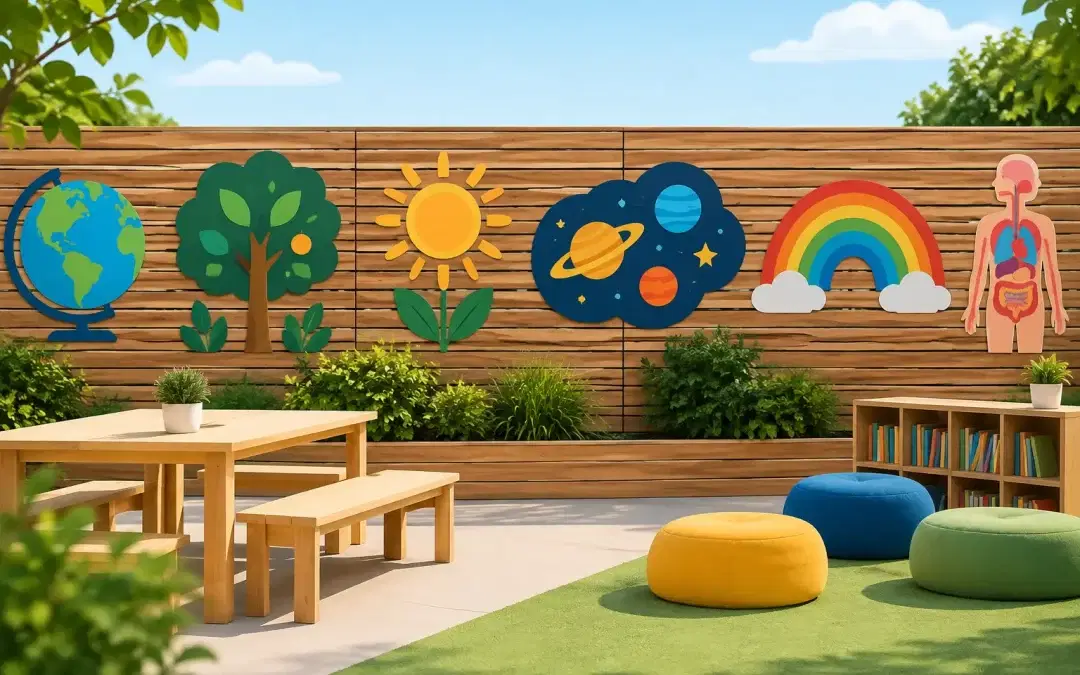
A corridor between lessons can be more than a route from English to maths. With the right educational wall graphics, those few minutes become a chance to revisit key vocabulary, spot a historical timeline, practise times tables or absorb a positive reminder about behaviour and belonging. Every wall has the potential to support the school day.
For busy UK schools, this is not about adding decoration for its own sake. It is about making the environment work harder for pupils and staff. A well-planned display programme brings curriculum content into the shared spaces where pupils queue, wait, move and gather, creating passive learning opportunities without placing another demand on lesson time.
Why educational wall graphics matter
Pupils learn in more places than their classrooms. A science display beside the laboratory can reinforce scientific enquiry language before a practical starts. A world map outside a geography room can prompt questions long after the lesson has ended. In EYFS, bright and carefully structured visuals can support early language, number recognition, routines and independent exploration.
Repeated visual exposure matters because it makes key ideas familiar. A pupil may not memorise every fact from a single glance at a timeline or grammar guide, but regular contact helps build recognition and recall. For teachers, that means walls can reinforce the vocabulary, processes and knowledge they are already teaching, rather than competing with it.
The impact also extends beyond academic subjects. Values displays, wellbeing messages, attendance expectations and anti-bullying guidance give schools a consistent visual language. When pupils see the same clear messages in reception, corridors, dining halls and playgrounds, the school ethos feels present rather than confined to a policy document or assembly.
Start with the spaces pupils use most
The most effective displays are planned around purpose, not simply around empty wall space. A school does not need to transform every surface at once. Begin with the locations that have high footfall or a clear learning opportunity, then build a cohesive visual scheme over time.
Corridors and stairwells
Corridors are ideal for curriculum sequences that pupils can revisit in short bursts. Primary schools may choose number facts, phonics, punctuation or topic-based history displays. Secondary schools can use these spaces for subject-specific knowledge organisers, literary quotations, scientific units and revision prompts.
Stairwells work particularly well for sequential content. Number lines, timelines, inspirational reading routes or key dates can give a journey through the building a clear educational focus. The important consideration is viewing distance: content needs strong headings, clear contrast and readable text rather than a dense page enlarged onto a wall.
Reception, halls and dining areas
Reception is often where a school makes its first impression on families, visitors and prospective staff. School values, safeguarding messages, community partnerships, pupil achievements and a visual statement of the school vision can create an immediate sense of pride and purpose.
Dining halls and shared halls offer a different opportunity. These spaces bring together pupils from several year groups, so displays should be inclusive and easy to understand at a glance. Healthy eating guidance, British values, mental wellbeing content, cultural celebrations and school rules can all have a natural home here.
Outdoor walls and playgrounds
Playgrounds are frequently underused as learning spaces, despite being some of the most visible areas on site. Weatherproof educational panels can turn a plain perimeter wall into an outdoor maths trail, an alphabet and phonics resource, a nature-learning zone or a collection of cooperative playground games.
Outdoor content needs to be selected with the environment in mind. Information should be bold enough to read in changing light and engaging enough to draw pupils in during breaktimes. A panel that supports active play or prompts discussion may be more valuable outdoors than a text-heavy curriculum explanation.
Match content to phase, subject and school priorities
The right educational wall graphics depend on who will see them and what the school wants them to achieve. EYFS environments benefit from clear imagery, familiar routines, early learning themes and language-rich prompts. Primary displays can support the breadth of the curriculum while helping pupils make connections between subjects. Secondary settings often gain most from department-led displays that make subject knowledge visible beyond individual classrooms.
A history department might use a local-history timeline to connect national events with the community pupils know. A food technology area could feature food safety, nutrition and kitchen vocabulary. English departments may choose literary heritage, writing techniques or genre-based displays, while maths corridors can reinforce methods, symbols and mathematical language.
There is a trade-off between covering everything and making each message memorable. A large display packed with facts can be useful near a classroom where teachers refer to it regularly. In a busy main corridor, fewer ideas with stronger visual hierarchy usually have greater impact. Content should suit the amount of time pupils have to engage with it.
Build a visual identity pupils recognise
Curriculum reinforcement is stronger when it feels part of the school rather than an off-the-shelf addition. Bespoke design allows schools to incorporate their logo, house colours, values, community rules and local context across different displays. This creates consistency while giving departments and year groups room to express their own subject identity.
Customisation is particularly valuable for schools that have developed their own behaviour language, wellbeing approach or curriculum model. Pupils are more likely to understand and use phrases that staff already employ in classrooms and assemblies. A display can then become a practical reference point: something a teacher can point to, discuss and return to throughout the week.
This is also an opportunity to represent the school community accurately. Local landmarks, pupil voice, cultural heritage and photographs or illustrations that reflect the community can make a space feel more relevant and welcoming. The aim is not to fill a wall with branding. It is to make the learning environment visibly belong to the people who use it.
Choose materials that suit a working school
Displays in schools face constant contact. Bags brush against corridor walls, pupils lean on panels, cleaners need surfaces that can be maintained quickly, and outdoor signs must withstand changing weather. Material choice is therefore a practical procurement decision as well as a design decision.
For interior installations, rigid foam-board panels provide a smart, durable finish while remaining manageable for in-house fitting. Protective wipe-clean laminate helps staff keep displays looking fresh in high-traffic areas, particularly near entrances, dining spaces and younger pupils’ zones. UV-stable inks help colours remain clear and vibrant rather than fading prematurely.
For playgrounds and external walls, composite aluminium panels offer the weather resistance needed for year-round use. These panels are designed for exterior environments, with UV-guaranteed inks and a hard-wearing finish that supports a long-term investment in outdoor learning.
Installation should not become a major site project. Panels supplied in practical sizes can be positioned by a school team using a planned layout, saving time and reducing disruption. Before ordering, measure the available wall area carefully, account for doors, radiators, noticeboards and sightlines, and consider whether pupils will view the display from close range or across a larger space.
Plan for use, not just installation
The strongest wall displays are introduced as teaching tools. Staff can refer to them during transitions, use them as retrieval prompts, set short observation tasks or build displays into tutor-time discussions. A visual resource becomes much more valuable when pupils understand that it is there to be used, not merely passed.
It helps to nominate a curriculum lead, phase lead or department representative to decide what success looks like. That might be improved confidence with subject vocabulary, stronger recall of key facts, more consistent behaviour language or a more welcoming entrance for families. Reviewing displays each term also helps identify content that should be refreshed, moved or expanded.
A phased approach often suits budgets best. Start with one priority route through the school, such as the main corridor, EYFS outdoor area or reception, then add complementary displays as funding allows. This keeps decision-making focused and lets staff see how pupils respond before extending the scheme.
Wall Graphics for Schools designs curriculum-aligned indoor and outdoor panels that help schools turn overlooked surfaces into dynamic, immersive learning environments. From durable interior foam board to weatherproof composite aluminium, the right specification makes it straightforward to create displays that look purposeful and continue working day after day.
The next blank wall pupils pass may be a missed opportunity – or it may become the prompt that helps a child remember a fact, ask a question, make a positive choice or feel that they belong.