
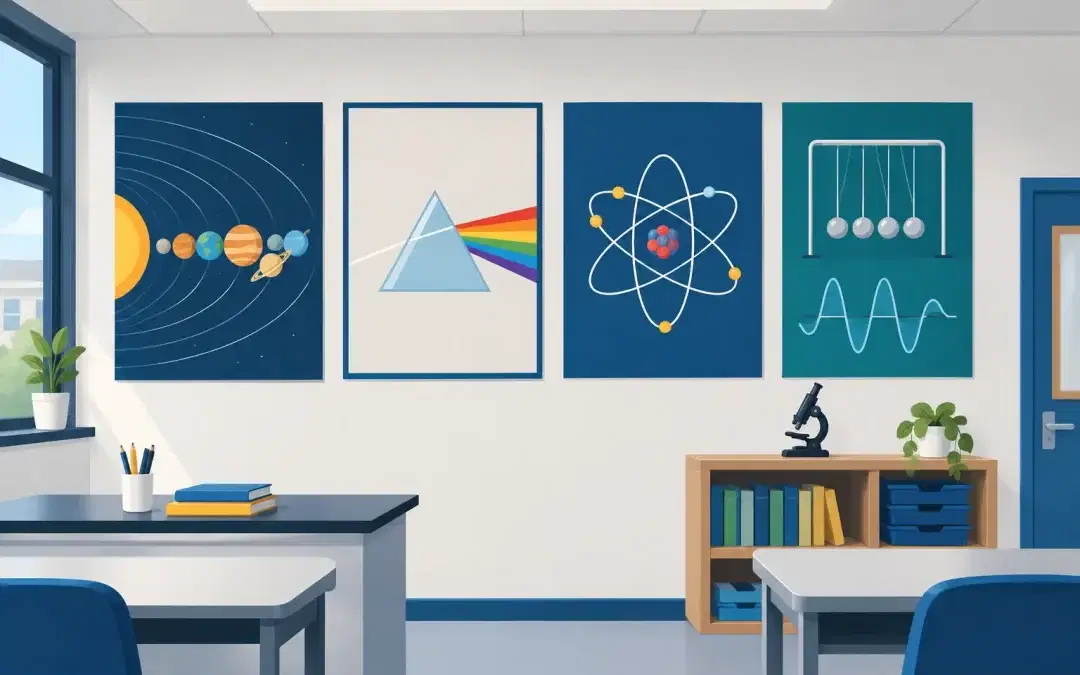
A pupil waiting for a practical demonstration to begin, lining up outside a laboratory or walking through a science corridor is still surrounded by opportunities to learn. A well-planned physics classroom wall display turns those moments into useful reinforcement, placing key vocabulary, equations and real-world applications where pupils can return to them again and again.
Physics can feel abstract when ideas are confined to exercise books and whiteboards. Forces cannot always be seen, energy transfers can be misunderstood and equations can become disconnected from the phenomena they describe. Purposeful visual displays help make the subject more visible, more memorable and more connected to the world pupils recognise.
Make the physics curriculum visible
The strongest displays do more than fill an empty wall. They support the sequence of learning already taking place in lessons, helping pupils revisit prior knowledge before it fades and giving staff a shared reference point during teaching.
For a secondary science department, this might mean a clear visual journey through the major physics themes: forces, energy, waves, electricity, magnetism, particle physics and space. In primary settings, the focus may be on accessible scientific language, famous physicists, light and shadows, sound, materials or seasonal change. The appropriate level depends on the age group, the curriculum and how the space is used.
A display beside a laboratory entrance can introduce the practical habits pupils need every day. A corridor wall can reinforce a whole topic over several weeks. A dining hall or communal area may be better suited to striking science facts, careers in STEM and messages that build curiosity beyond the lesson timetable. Each location has a different job to do.
Start with concepts, not decoration
Colourful graphics attract attention, but their educational value comes from clarity. A physics display should give pupils something useful to notice, recall or discuss. That could be the relationship between force, mass and acceleration; the energy stores involved in a rollercoaster; or a labelled explanation of the electromagnetic spectrum.
Keep the central learning point easy to find. Strong headings, carefully selected diagrams and concise explanations allow pupils to take in information quickly as they pass. Equations work best when they are accompanied by units, symbol definitions and a practical example, rather than appearing as isolated formulae.
For example, an electricity display can show circuit symbols alongside a simple series circuit, the difference between current and potential difference, and examples of electrical safety. This makes it useful to a Year 8 pupil building circuits for the first time as well as a GCSE pupil revising essential language.
Build displays around the moments pupils need them
A physics classroom wall display has greatest impact when it reflects the daily experience of staff and pupils. Think about where misconceptions occur, where pupils pause between activities and what they need to remember without opening a textbook.
In a busy science classroom, a visual reference wall near practical benches can support independent work. Labelling key equipment, safety expectations and common measurements helps pupils settle more quickly and gives teachers a consistent prompt to refer to. In a corridor, a larger display might map the physics curriculum across key stages, showing how early learning about pushes and pulls develops into the study of resultant forces and motion.
Displays can also support retrieval practice without becoming a test on the wall. A panel featuring core units, prefixes and scientific quantities gives pupils repeated exposure to the language that underpins calculations. A graphic showing energy transfers in familiar settings – a kettle, a bicycle, a phone charger or a playground swing – encourages pupils to see physics in everyday life.
There is a balance to strike. A wall crowded with dense text, too many competing colours or every topic taught in a year can be difficult to use. It is often more effective to give each panel a clear purpose and use a coordinated set of displays across the department or wider school.
Use visual design to support recall
Repeated visual exposure is valuable because pupils encounter important content outside the pressure of a formal task. Over time, a familiar diagram, keyword or equation becomes easier to retrieve. This does not replace high-quality teaching, practical investigation or deliberate revision. It extends their reach into the wider school day.
Visual consistency helps. Using the same symbols, colour groupings and layout principles across science spaces can make a department feel organised and easier to navigate. A defined colour for energy, another for forces and a consistent treatment of key vocabulary can help pupils recognise the topic at a glance.
Images should earn their place. Photographs of turbines, satellites, bridges and medical imaging equipment can show where physics matters beyond school, particularly when paired with an explanation pupils can understand. Portraits and short stories of physicists can also broaden pupils’ sense of who works in science, but they are most effective when linked directly to a discovery, question or application.
For schools developing careers education, this is an opportunity to make pathways visible. Physics supports roles in engineering, architecture, renewable energy, healthcare, games design, aviation and data science. A carefully designed careers panel can challenge narrow assumptions while showing pupils why the subject is worth sustained effort.
Choose materials that suit a busy school
Educational impact is only part of the decision. School walls experience constant contact from bags, chairs, cleaning routines and large numbers of pupils. Displays need to stay clear, clean and professional long after installation.
For interior physics areas, durable rigid foam-board panels offer a practical finish that is lightweight and manageable for school teams to install. A wipe-clean protective laminate helps staff maintain a smart appearance in laboratories, corridors and shared areas where marks are inevitable. UV-stable inks help graphics retain their colour and legibility over time.
Outdoor science trails, playground learning zones and exterior walls require a different specification. Weatherproof composite-aluminium panels are designed for external conditions, giving schools the confidence to create passive learning opportunities beyond the classroom without relying on temporary materials.
Panel format matters too. Large wall transformations can be supplied in manageable sections, making transport and fitting more straightforward for in-house site teams. This can be particularly useful where budgets are carefully planned or installation needs to happen around the school day.
Make it part of your school identity
A generic physics display can be useful, but a bespoke approach can make the learning environment feel owned by the school community. Department colours, school logos, local engineering landmarks, community links and your own scientific values can all be incorporated without losing curriculum focus.
A school near a wind farm, manufacturing site, research facility or historic railway may choose examples that pupils see in their local area. This makes concepts more tangible and creates natural conversation starters. Equally, a department may want displays that reflect its commitment to sustainability, inclusion or ambitious STEM pathways.
Customisation is not simply about branding. It allows staff to align visual content with the vocabulary, model answers and curriculum order pupils encounter in class. When a display uses familiar language, it becomes easier for teachers to reference naturally during explanations and for pupils to use independently.
A practical plan for your physics display
Before selecting artwork, walk the route pupils take through the science area. Identify blank walls, tired noticeboards and places where pupils gather. Then decide what each surface needs to achieve: reinforce knowledge, support practical routines, celebrate science or create a stronger sense of department identity.
Involve the physics lead and site team early. The physics lead can prioritise content that supports the curriculum, while the site team can advise on wall condition, dimensions, fitting and the most suitable materials. If budgets need to be phased, begin with the highest-footfall space or the topic where pupils would benefit most from a permanent visual reference.
Wall Graphics for Schools can help schools turn these decisions into curriculum-aligned panels designed for the realities of a busy site. The result is not a classroom that simply looks better. It is a dynamic, immersive learning environment where a corridor wall, laboratory entrance or shared science space continues teaching long after the lesson bell has gone.