
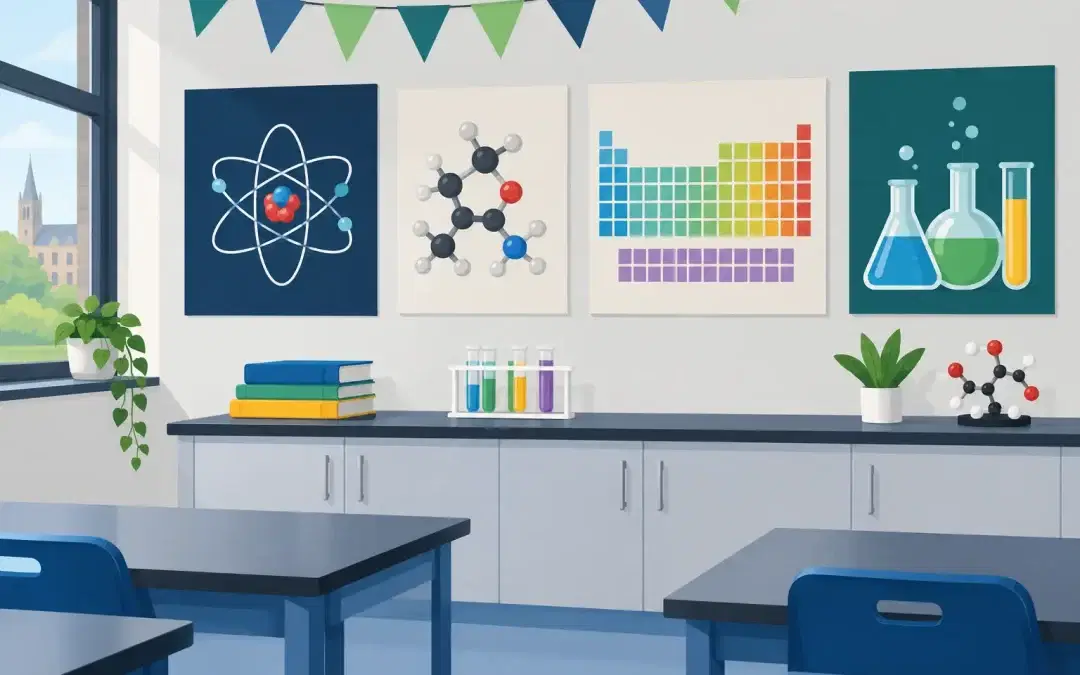
A pupil waiting for goggles at the start of a practical is not simply waiting. They are looking around the room, talking through the task ahead and forming expectations about the lesson. Well-planned chemistry classroom wall displays make those moments useful, placing the language, patterns and safe-working routines of the subject where pupils can see them every day.
Chemistry can feel abstract when it remains confined to worksheets, textbooks and a whiteboard that is wiped clean at the end of each lesson. Visible, curriculum-aligned graphics give key ideas a permanent place in the department. They support recall between lessons, provide prompts during practical work and help pupils see that chemistry is a connected body of knowledge rather than a sequence of isolated topics.
Why chemistry displays earn their wall space
A science classroom has to work hard. It must support demonstrations, practical investigations, written work, discussion, equipment storage and movement between activities. Blank walls, or faded posters with too much small text, do little to help. Purposeful displays extend teaching beyond the teacher’s immediate explanation.
Repeated visual exposure matters because pupils encounter concepts more than once and in more than one context. A periodic table near the working area can support a quick question about groups and periods. A particle-model display can prompt a Year 7 pupil to explain a change of state. A clear reminder of hazard symbols and laboratory expectations reinforces the routines that make practical science calm and safe.
For staff, the value is practical as well as educational. A well-positioned display reduces the need to recreate the same reference points on the board and gives pupils something reliable to consult independently. This is particularly helpful during transitions, retrieval activities and mixed-attainment lessons, where some pupils need a visual cue before they are ready to contribute.
Chemistry classroom wall displays for each stage of learning
The most effective display programme reflects what pupils are learning now while retaining the foundations they will revisit later. It is not a matter of covering every available surface. Too much visual information competes for attention; the right content, in the right location, supports teaching without overwhelming the room.
Building confidence at Key Stage 3
At Key Stage 3, displays should make the language of chemistry familiar. Particle arrangements, elements and compounds, acids and alkalis, separating techniques and simple energy changes all benefit from concise diagrams and accurately labelled vocabulary. These are the concepts pupils return to repeatedly as their understanding grows.
The periodic table is often the visual anchor of a chemistry room, but it should be legible from across the classroom and designed for the age group using it. Pairing it with displays that explain atomic structure, chemical symbols and common formulae helps pupils move beyond memorising a chart towards understanding how it is used.
For pupils who find scientific vocabulary challenging, clear visual links can be especially valuable. A display showing filtration, evaporation, distillation and chromatography alongside their equipment and outcomes provides an immediate reference during an investigation. It supports the whole class without singling anyone out.
Supporting GCSE and post-16 study
Older pupils need displays that prompt precision. Topics such as bonding, electrolysis, rates of reaction, quantitative chemistry and organic chemistry contain ideas that build steadily over time. A carefully designed wall graphic can keep essential definitions, conventions and models visible while students practise applying them.
There is a balance to strike. GCSE classrooms do not need every equation and exception printed permanently on the wall. Instead, prioritise durable reference content: command words, required practical principles, common ion tests, reactivity patterns and the conventions used in balanced symbol equations. Department-specific displays can then reflect the examination courses and sequences taught in your school.
Post-16 spaces may benefit from more detailed subject language, but readability remains essential. Displays should help students think, not become wallpaper. Strong hierarchy, clear diagrams and enough space around key information matter as much as the content itself.
Put the right information where pupils need it
Location changes how a display is used. A large periodic table belongs where it can be seen from most student workspaces. Practical-method graphics are most useful near benches or preparation areas. Safety expectations should be positioned at the point pupils enter or begin practical work, rather than hidden behind equipment or placed in a corridor they pass only occasionally.
Corridors offer a different opportunity. Chemistry-themed wall displays can turn movement between lessons into passive learning opportunities, particularly when they feature striking imagery, short explanations and memorable examples from everyday life. The chemistry of food, materials, medicines, atmosphere and energy can make the subject feel relevant beyond the laboratory.
Reception and department entrances are also valuable spaces. They can celebrate the science curriculum, showcase careers and communicate the ambition of the department to pupils, visitors and families. A display incorporating school colours, a science faculty identity or pupil-designed elements can build pride without losing its teaching purpose.
When choosing content, schools commonly gain most value from a balanced set of displays covering:
- core knowledge, including the periodic table, atomic structure and particle theory;
- practical science, such as laboratory rules, hazard symbols and equipment use;
- topic-specific prompts for the curriculum currently taught; and
- chemistry in everyday life, careers and real-world applications.
This combination serves different moments in the school day. It supports direct classroom teaching, reinforces routines and gives pupils reasons to be curious about where chemistry can take them.
Design for busy school environments
A display may be educationally excellent, but it still needs to withstand the reality of a busy school. Chemistry rooms and communal areas experience constant contact, moving chairs, bags, cleaning and occasional splashes. Paper posters curl, tear and quickly lose their impact, while displays protected behind fragile frames can create another maintenance task for site teams.
For indoor areas, rigid foam-board panels provide a smart, manageable solution. They are lightweight enough for straightforward in-house installation, yet provide a clean, professional finish that transforms a tired wall into a purposeful learning surface. A wipe-clean protective laminate helps staff maintain a hygienic, presentable environment, especially in practical spaces.
Outdoor chemistry displays need a more resilient specification. Weatherproof composite-aluminium panels are suited to playground walls, covered walkways and external teaching areas. UV-stable inks help graphics retain their colour and clarity in changing British weather, allowing science learning to continue beyond the classroom walls.
Panel size is worth considering before ordering. One large statement graphic may work well in an open corridor, while several smaller panels can be easier to position around doors, storage cupboards and existing fixtures. Manageable formats also make installation more practical for schools coordinating work through their own site team.
Make the display feel like it belongs to your school
Off-the-shelf curriculum content is a strong starting point, but bespoke design can make chemistry displays more meaningful. A school might include its logo and colours, link chemistry examples to local industry, or feature its own laboratory rules and values. A coastal community could connect displays to water quality and marine materials; an area with a manufacturing heritage could highlight polymers, metals or engineering pathways.
Customisation is most effective when it serves a clear purpose. Adding a logo everywhere is not the same as creating a coherent visual identity. The best bespoke graphics reflect the language pupils hear from staff, the curriculum sequence they follow and the wider culture the school wants to strengthen.
Wall Graphics for Schools can help schools create this kind of coordinated approach, combining curriculum-aligned content with colours, branding and local context. The result is more than decoration: it is an educational environment that continues working between lessons.
Plan displays with staff, not around them
Before selecting graphics, walk the chemistry area with the teachers and site team who use it daily. Identify where pupils pause, which walls are visible from seating, where practical instructions are most often repeated and which surfaces are likely to receive heavy contact. This prevents a good display from being installed in a place where it cannot do its job.
It also helps to decide what needs to remain permanent and what should change. Core reference graphics are a long-term investment. Topic work, pupil outcomes and current investigation questions may be better displayed on designated noticeboards alongside them. Together, these create a dynamic, immersive learning environment without requiring staff to redesign the room every term.
The best chemistry wall display is not the one with the most facts. It is the one a pupil notices at the right moment, understands clearly and uses with growing confidence. Give each wall a purpose, and it can keep teaching long after the lesson bell has rung.