
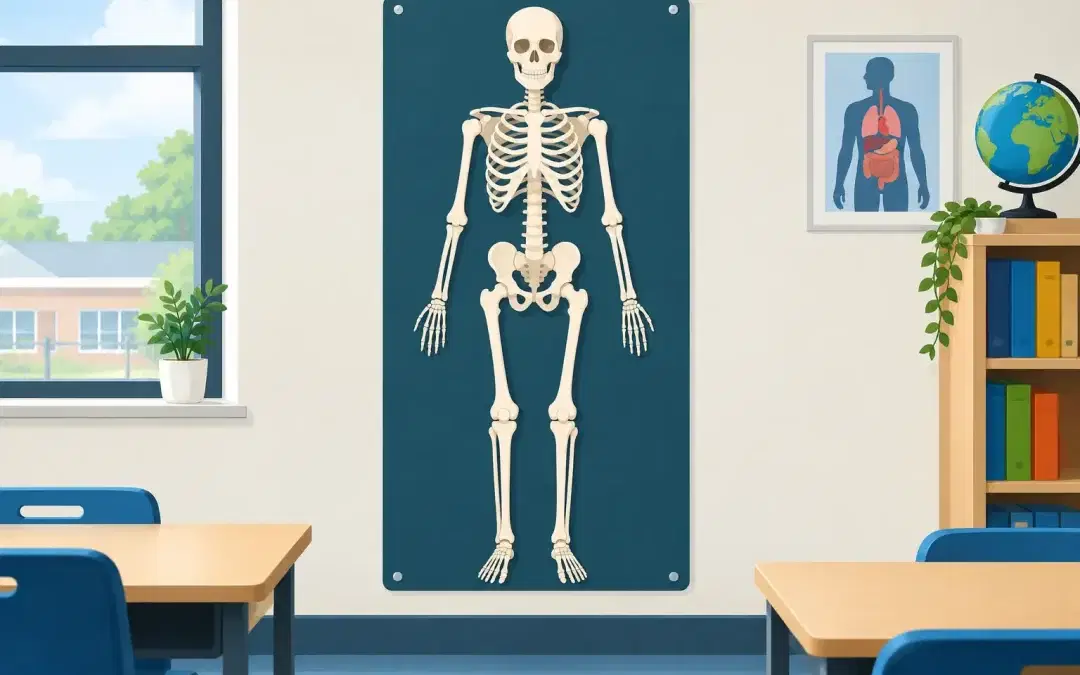
A pupil waiting outside a science lesson can learn more than they realise from a well-designed human body skeleton wall display. A clear, labelled visual turns an ordinary corridor, classroom or shared learning area into a passive learning opportunity: bones become familiar, scientific vocabulary is visible and questions can begin before the lesson starts.
For UK schools, this is not simply a decorative science poster. It is a practical way to reinforce curriculum learning repeatedly, support recall and make the human body feel approachable for pupils across primary and secondary phases. When wall space is planned with purpose, it helps build the dynamic, immersive learning environment that pupils remember.
Why a human body skeleton wall display earns its space
The skeleton is one of the most recognisable starting points in human biology, yet pupils can find its terminology difficult to retain. Words such as cranium, clavicle, pelvis, vertebrae and femur are far easier to revisit when they are displayed in context, rather than encountered only in a worksheet or presentation.
A human body skeleton wall display gives staff a permanent visual reference point. Teachers can direct pupils to it during a lesson, use it for quick retrieval practice or refer to it while discussing movement, protection, growth and health. Pupils, meanwhile, encounter the content naturally during transitions, lining up, breaktimes and movement between classrooms.
This repeated visual exposure matters because it makes subject language part of the school environment. Rather than feeling like unfamiliar vocabulary reserved for science books, key terms become recognisable parts of everyday learning. That can be particularly valuable for pupils who benefit from visual prompts, including those with additional learning needs or those developing confidence with technical language.
The educational value depends on placement and design. A detailed secondary biology display may be ideal outside laboratories or in a science corridor, while a simpler, brightly structured skeleton graphic can support Key Stage 1 and Key Stage 2 learning. The most effective display is not necessarily the one with the most information. It is the one pupils can read, revisit and use at the right stage of their learning.
Extending science beyond the classroom
Science learning does not need to stop at the classroom door. A skeleton display can connect naturally with several curriculum themes, helping staff make better use of communal areas that might otherwise remain blank or tired.
In primary schools, it can support work on animals including humans, healthy bodies, movement and senses. In secondary settings, it provides a useful foundation for anatomy, muscles, joints, exercise, sport science and health education. A display near a PE changing area or sports hall can be especially effective when it links bones and joints to movement, injury prevention and physical wellbeing.
There is also scope for meaningful cross-curricular conversation. Pupils may consider how medical imaging helps doctors see bones, how diet supports bone health, or how historical discoveries have developed scientific understanding. A carefully designed wall graphic gives teachers an accessible prompt for these conversations without requiring additional preparation every time.
For schools strengthening their wellbeing provision, human body graphics can also help pupils view their bodies as systems worth understanding and caring for. The tone should remain factual, age-appropriate and positive. The aim is to encourage curiosity and knowledge, not overwhelm pupils with unnecessary clinical detail.
Supporting recall in busy school days
School life is full of short intervals: the minutes before registration, the walk to lunch, the pause while a class lines up. These moments may not replace focused teaching, but they can reinforce it. A pupil who sees the same labelled skeleton over several weeks has more opportunities to recall the names and locations of bones.
Staff can make this even more purposeful with simple verbal prompts. Ask pupils to find the ribcage, identify a bone that protects an organ, or name the longest bone they can see. These small interactions create low-pressure revision opportunities and help science feel present throughout the school day.
Choosing the right skeleton display for your setting
The right design starts with the pupils who will use it. Early years and younger primary pupils generally benefit from uncluttered graphics, familiar language and strong visual cues. Older primary pupils may be ready for more labelled bones and simple explanations of the skeleton’s functions. Secondary pupils can use more detailed anatomical terminology and content that supports biology teaching directly.
It is worth considering sightlines too. A display positioned where pupils can stop safely and view it at eye level will be used more readily than one placed high above a busy walkway. Wider corridors, science departments, libraries, dining halls and stairwell landings can all work well, provided the display does not compete with essential safety signage or create visual clutter.
Colour and layout should make information easier to follow. Clear headings, legible labels and purposeful use of colour help pupils distinguish different areas of the skeleton. A visual that is crowded with small text may look comprehensive, but it is less likely to function as an everyday learning tool from a corridor distance.
Standard content or a bespoke school display?
A standard curriculum-focused design is a straightforward choice when a school needs a ready-to-install science resource. Bespoke design is valuable when the display needs to reflect a particular scheme of learning, department identity or wider school environment.
For example, a school may want its science colours, logo or house style incorporated into a human body skeleton wall display. Others may add a short set of retrieval questions, healthy-living messages or links between the skeletal system and PE. This approach can help the display feel like an integrated part of the school, rather than an item added afterwards.
Customisation should still protect clarity. A school logo can strengthen ownership, but it should not distract from the anatomy content. The display’s first job is to make learning visible.
Materials that suit real school walls
Educational wall displays work hard. They are seen every day, often touched by pupils and regularly cleaned by site teams. Material choice therefore matters as much as the artwork.
For indoor areas, rigid foam-board panels offer a practical, lightweight option. They create a smart, substantial finish that is suitable for classrooms, corridors, reception spaces and shared areas. A wipe-clean protective laminate helps the display remain presentable in high-contact environments, making routine maintenance simpler for busy staff.
For exterior walls, playground areas and covered outdoor learning spaces, weatherproof composite-aluminium panels are the more suitable choice. These are designed for demanding conditions and provide a durable surface for science learning beyond the building. UV-stable inks help maintain clear colours and legibility over time, which is particularly important for displays exposed to daylight.
The indoor or outdoor decision is not only about weather. Consider how pupils will use the space. A playground science trail may encourage active discussion and movement, while an indoor corridor display can support quiet observation and regular lesson references. Some schools benefit from both, using the same visual theme to create continuity across the site.
Installation without adding pressure to the site team
A wall display should improve a space without becoming a complicated project. Panels supplied in manageable formats can be installed in-house, allowing schools to plan fitting around term dates, access requirements and normal site routines.
Before installation, check that the chosen wall is clean, dry and suitable for fixing. Measure the available area carefully, allowing for door swings, radiators, noticeboards and existing signage. It is also sensible to decide who will take responsibility for checking alignment and secure fixing, especially in areas used by younger pupils.
A planned display location has a longer life than one chosen in haste. When the skeleton graphic sits alongside related science content, or forms part of a wider corridor theme, it becomes easier for staff to use and easier for pupils to understand. One strong display can also provide the starting point for a broader human body, health or STEM wall.
Making the display part of teaching, not just the décor
The greatest return comes when staff refer to the display regularly. It does not need a separate lesson plan. A Year 3 teacher might use it to recap body parts before a unit on movement. A science technician may use it as a visible reference outside a laboratory. A PE lead could build short questions around joints and posture into a wellbeing week.
Pupil involvement can strengthen ownership too. Invite classes to create nearby work on protecting bones, healthy eating, famous medical discoveries or sporting movement. The permanent display provides accurate core knowledge, while pupil work shows how that knowledge is being explored in school.
Blank walls do not reinforce vocabulary, prompt questions or celebrate curriculum ambition. A well-placed skeleton display does all three, turning a familiar journey through school into another chance for pupils to notice, remember and grow in confidence.