
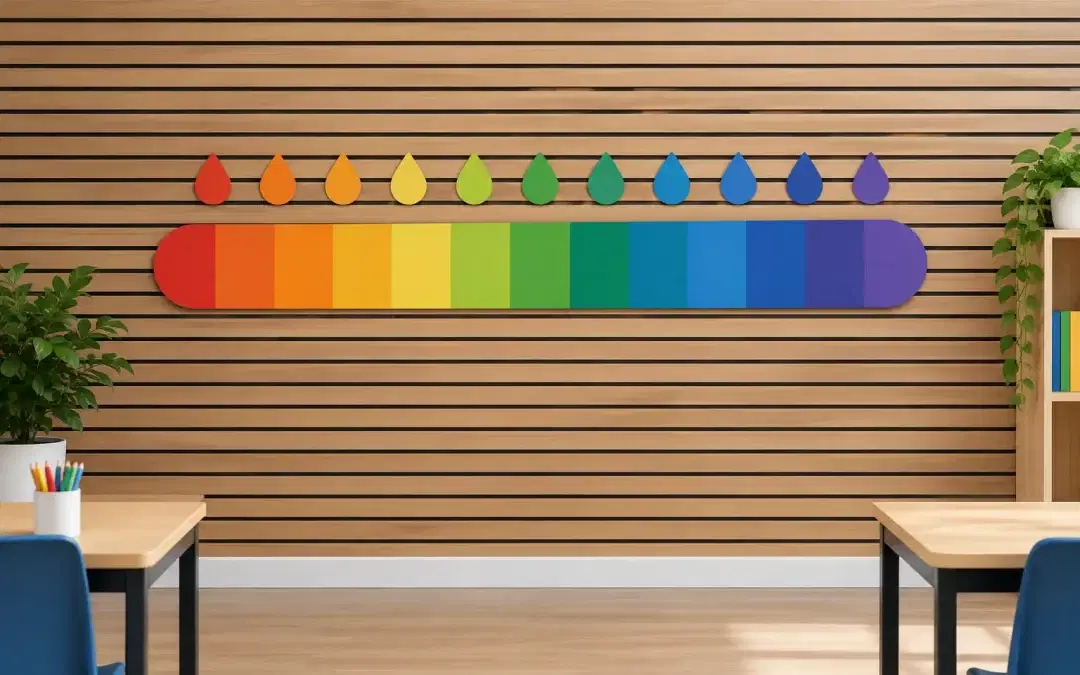
A pupil has just tested lemon juice, washing-up liquid and a mystery solution. The practical is lively, but the result can disappear as soon as the equipment is cleared away. A pH scale classroom wall display keeps the key learning visible: where acids and alkalis sit, what neutral means, and how familiar substances relate to the numbers pupils have recorded.
For busy science departments, this is not decoration for the sake of filling a wall. It is a practical, always-visible reference that extends teaching beyond a single lesson and gives pupils a clear point to return to during investigations, revision and corridor conversations.
Why a pH scale belongs on the science wall
The pH scale is introduced early, then revisited in greater depth as pupils move through the curriculum. At primary level, pupils may be comparing everyday materials and beginning to use the language of acidic, alkaline and neutral. In secondary science, they need to interpret numerical values, understand indicators, consider concentration and apply their knowledge in practical work.
A well-designed display supports this progression because it makes the relationship between the terms visible. Pupils can see that pH 7 is neutral, that lower values indicate increasing acidity and that higher values show increasing alkalinity. Rather than remembering disconnected facts, they have a visual structure for organising what they know.
Repeated visual exposure is particularly valuable in communal spaces. A display outside a laboratory can reinforce vocabulary while pupils wait for a lesson to begin. In a science corridor, it creates a passive learning opportunity between classrooms. In a dining hall or near a water fountain, it can prompt discussion about everyday examples without taking time away from planned teaching.
The strongest displays do not try to replace practical science. They make practical science easier to revisit. When pupils can glance at a scale showing universal indicator colours and common examples, they are better placed to explain what their observations mean.
What an effective pH scale classroom wall display should show
Clarity matters more than cramming every possible chemistry fact onto one panel. A pupil should be able to understand the main message from a few steps away, then find more detail when standing closer.
The scale itself needs to be prominent, running clearly from strong acids through neutral to strong alkalis. A consistent colour progression helps pupils connect the display to the indicator paper and solutions used in lessons. Labelling pH 0 to pH 14 gives the numerical framework that secondary pupils will need, while the words acidic, neutral and alkaline make the display accessible to younger learners.
Familiar examples give the information meaning. Lemon juice, vinegar, water, soap solution and bleach are often useful reference points, provided they are presented carefully as approximate examples. The precise pH of a household substance can vary by brand, dilution and formulation, so a school display should encourage scientific thinking rather than imply that every sample will produce an identical result.
For older pupils, additional prompts can add real teaching value. These might include the distinction between strong and weak acids, a reminder that pH is logarithmic, or short questions that ask pupils to predict the colour of an indicator. The right level depends on the setting. A primary corridor benefits from simple, confident explanations; a GCSE laboratory entrance can support more technical language and exam-focused recall.
Design for the pupils who will use it
A pH display should be legible at a distance, with a clear hierarchy between the scale, key terms and supporting examples. Avoid tiny text, overly decorative backgrounds and colour combinations that reduce contrast. The display must work for pupils moving past it as well as those stopping to study it.
It is also worth considering the needs of pupils with visual processing differences or colour-vision deficiency. Colour is central to the topic, but it should not carry the whole message. Clear labels, numbers, directional layout and descriptive wording ensure that more pupils can use the resource independently.
Choosing the right location
The best location is usually where it supports a real teaching routine. Outside science laboratories, a pH scale can become a natural retrieval prompt before practical lessons. In a classroom, it can sit near benches or a demonstration area where pupils need quick access to reference information. On a corridor wall, it helps turn transition time into a moment of low-pressure science learning.
A dining hall can also work surprisingly well, especially where schools are developing a wider culture of curiosity around food, nutrition and materials. However, the display needs enough surrounding space to be read comfortably. A narrow, crowded noticeboard area may limit its usefulness, however good the graphic is.
Outdoor placement needs a different specification. Interior displays are well suited to durable rigid foam-board panels with a wipe-clean protective laminate. For playground walls, exterior science trails and exposed areas, weatherproof composite-aluminium panels are the better choice. Finished with UV-stable inks and protective laminate, they are designed to keep their colour and withstand the constant contact expected in a busy school environment.
Make the display part of teaching, not background noise
Even the most striking wall graphic delivers more when staff give pupils a reason to use it. This does not require another lesson plan or a lengthy activity. A science teacher might begin practical work by asking pupils to identify where they expect a tested substance to sit on the scale. At the end of the lesson, pupils can use the display to check whether their results support their prediction.
For younger pupils, a quick corridor challenge can build confident vocabulary: is orange juice acidic, alkaline or neutral? For Key Stage 3, pupils can explain why pH 3 and pH 5 are both acidic but not equally acidic. For examination groups, the display can support retrieval of indicator colours and reinforce the precise language needed in written answers.
A pH scale also lends itself to cross-curricular conversation. Food technology teams may use it when discussing ingredients and preservation. Geography lessons may connect acidity to environmental topics. These links should be purposeful rather than forced, but they help pupils see that science is not confined to one timetable slot or one room.
Bespoke details that strengthen school identity
A curriculum display can still feel unmistakably part of your school. Adding school colours, a logo or a science department identity can make a corridor feel planned and cared for rather than assembled from unrelated posters. This is especially useful where schools are refreshing a whole block, developing a STEM area or creating a consistent visual language from reception to the playground.
Customisation can also make a display more relevant to the local community. A coastal school may want to connect the topic to seawater and environmental science. A school with a strong horticulture project could reference soil testing. The key is to retain scientific accuracy and keep the central pH scale easy to read.
Wall Graphics for Schools can create customised curriculum-aligned panels in manageable formats, helping schools build a dynamic, immersive learning environment without creating an installation headache for site teams. Panels are designed for straightforward in-house fitting, which can be particularly helpful when work must be scheduled around teaching, safeguarding and busy school calendars.
A durable investment for a hard-working wall
School walls face more than occasional attention. They are brushed by bags, touched by curious hands and cleaned regularly. Paper posters can quickly look tired, particularly near laboratories, sinks, corridors and communal areas. Choosing a purpose-made, wipe-clean display helps maintain a professional standard while reducing the cycle of replacing damaged material.
There is a budget decision here, as there always is. A temporary poster may suit a short topic or a one-off event. A permanent pH reference is different: it supports knowledge that pupils revisit year after year. When selected at the right scale, installed in a useful location and matched to the environment, it becomes a reliable teaching asset rather than another item for staff to update.
A blank science wall asks nothing of pupils. A clear, durable pH scale invites them to notice, question and connect what they see in the classroom with the world around them.